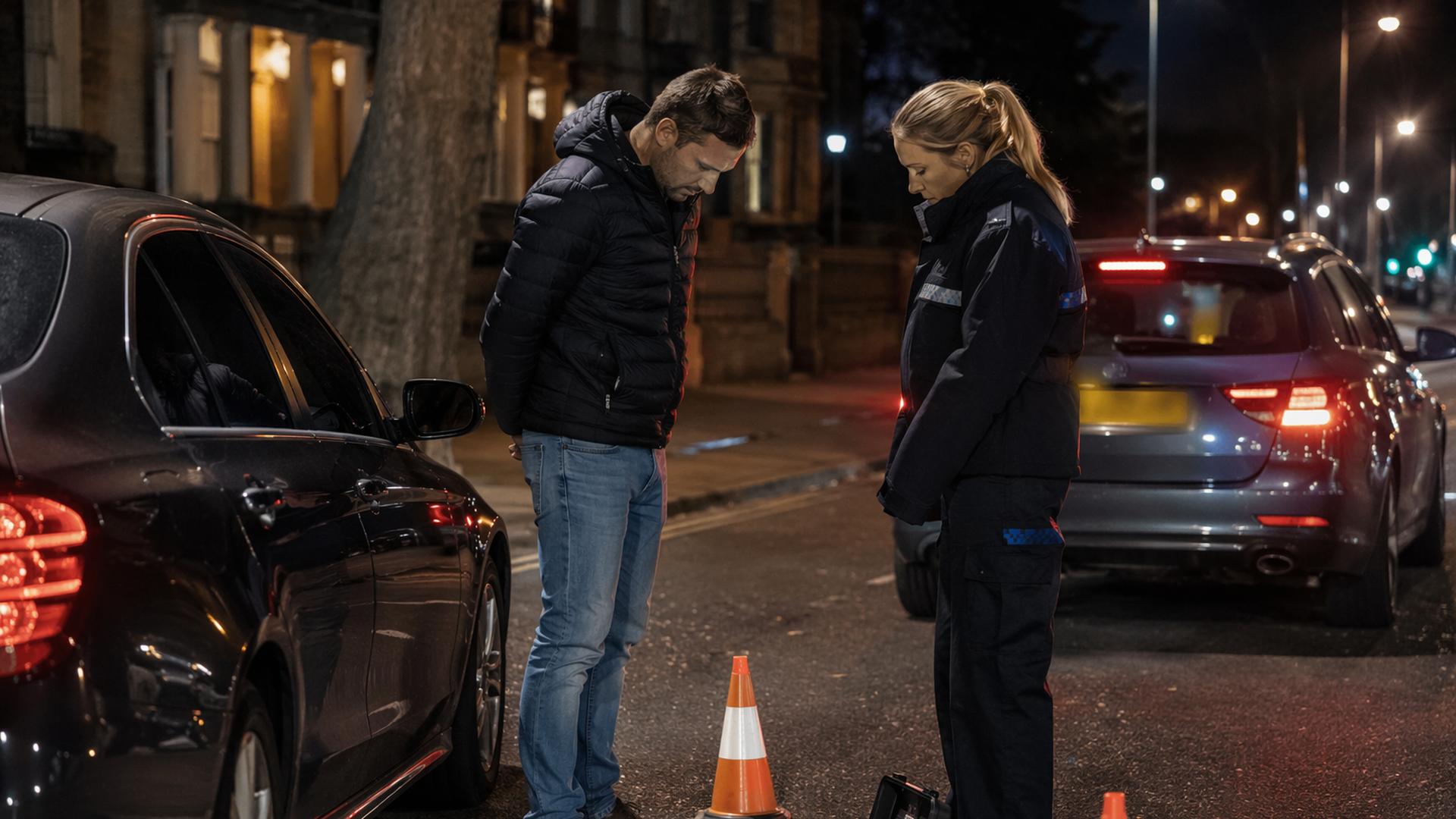
7 Immediate Outcomes After a Failed Roadside Drug Test in the UK
Published by Drug Driving Solicitors, specialist defence lawyers for drug driving charges across England and Wales.
Failing a roadside drug test is a stressful and often disorienting experience. For many drivers, it is the first time they have had any contact with the criminal justice system, and the sequence of events that follows can feel both confusing and intimidating. Understanding what happens at each stage does not make the situation easier to face, but it does mean you are not navigating it in the dark.
This article walks through the seven key outcomes that follow a failed roadside drug test in the UK, from the moment a screening device returns a positive result to the point at which a court considers your case. Each stage has its own procedural rules, and knowing what to expect at each one can help you make informed decisions, particularly around when and how to seek legal advice.
The Roadside Device Produces a Positive Reading
The sequence of events begins the moment an officer decides to administer a roadside drug screening test. These tests are usually carried out using a type-approved oral fluid device, which detects the presence of certain controlled substances, including cannabis and cocaine. A positive reading does not, on its own, confirm that you have committed an offence, but it does trigger a formal process that will follow a defined legal pathway from that point onwards.
It is worth understanding that the roadside device is a screening tool rather than a forensic instrument. Its role is to identify drivers who may be over the specified limit, not to provide the evidential standard required for a prosecution. A positive result is the starting point, not the conclusion. That distinction matters, and it is one of the reasons why a positive roadside reading does not automatically lead to a conviction.
The devices used on UK roads must be type-approved by the Home Secretary for the specific substance they are being used to detect. If an officer uses a device that is not approved for a particular drug, any evidence obtained may be challengeable. This is the kind of procedural detail that a specialist solicitor will examine as a matter of course when reviewing the circumstances of a case.
Key points at this stage include:
- Only type-approved devices may be used for roadside screening
- A positive result triggers an arrest power, not an automatic charge
- The result is a screening indication, not forensic proof of an offence
- The substances most commonly detected include cannabis (THC) and cocaine
You Are Arrested and Taken to a Custody Suite
Following a positive roadside reading, the officer will typically arrest you under Section 5A of the Road Traffic Act 1988 on suspicion of driving with a controlled drug above the specified limit. You will be transported to a police custody suite, where your detention will be formally authorised by a custody sergeant. At this point, your rights will be read to you, and you will be told that you are entitled to free legal advice.
The right to speak with a solicitor before answering questions or providing a specimen is one of the most important rights available to anyone in police custody. It is a right that should always be exercised. A solicitor can advise you on your specific circumstances, explain what the process involves, and help you avoid making decisions that could later complicate your defence.
Once in custody, you will be booked in and your details recorded. The custody record created at this stage becomes a formal document in any subsequent proceedings, and it will note the time of your arrest, the grounds for your detention, and any requests you make including requests for legal advice. Every step of the custody process is documented, which itself creates a record that can be scrutinised later if procedural questions arise.
Key points at this stage include:
- Arrest is made under Section 5A of the Road Traffic Act 1988
- You have an absolute right to free and independent legal advice in custody
- You should request a solicitor before speaking to officers or providing any specimen
- The custody record is a formal document that can later be reviewed by your legal team
The Officer Administers a Statutory Warning
Before officers can require you to provide a blood sample at the custody suite, they must first administer a statutory warning under Section 7A of the Road Traffic Act 1988. This warning formally notifies you that a positive result from the approved roadside device has been obtained, and that you are now required to provide a specimen of blood for laboratory analysis. The warning is a legal prerequisite, not an optional formality.
The precise wording and delivery of this warning matters considerably. If the warning is not given correctly, or if it is given in circumstances where it cannot reasonably have been understood by the person receiving it, the subsequent requirement to provide a blood specimen may be open to challenge. Courts have considered cases where the validity of the warning has been disputed, and the outcome has turned on the specific facts of how it was administered.
This is one of the procedural steps that a specialist solicitor will examine carefully when reviewing a case. A failure at this stage does not automatically result in charges being dropped, but it can form the basis of a substantive legal argument. The integrity of every step in the process is capable of being scrutinised, and the statutory warning is no exception.
Key points at this stage include:
- The statutory warning is a legal requirement before a blood specimen can be requested
- It must be properly administered and understood by the person being warned
- Errors in how the warning is given can form grounds for a legal challenge
- This step is separate from the general rights read to you at the point of arrest
A Healthcare Professional Takes a Blood Sample
The blood specimen at a custody suite must be taken by a healthcare professional, typically a police doctor, forensic medical examiner, or registered nurse. This requirement exists to ensure that the sample is obtained safely and that the process meets the evidential standards required for court. An officer cannot take the sample themselves, and the involvement of a qualified professional is a procedural safeguard built into the legislation.
Before the sample is taken, you will typically be offered the opportunity to have your own part of the divided sample. The blood specimen is split into two portions: one is retained by the police for laboratory analysis, and one is offered to you. Accepting your portion allows you to have it independently analysed, which can be significant if you intend to challenge the results. Refusing your portion is not an offence, but accepting it preserves options for your defence.
The healthcare professional will document the circumstances of the blood draw, including the time it was taken and any observations relevant to your condition. This documentation forms part of the evidence chain and may be relevant if any questions arise about the integrity of the sample or the circumstances in which it was obtained.
Key points at this stage include:
- Only a qualified healthcare professional may take the blood specimen
- The sample is divided, and you are entitled to your own portion
- Accepting your portion allows for independent analysis by your own expert
- The healthcare professional's notes form part of the evidential chain
The Blood Sample Is Sent for Laboratory Analysis
Once the blood specimen has been obtained and the custody process is complete, the police portion of the sample is sent to the force's nominated laboratory for forensic analysis. This is the stage at which the actual concentration of any controlled drug in your blood is measured and compared against the specified limits set out in the legislation. The results of this analysis form the cornerstone of any subsequent prosecution.
The laboratory analysis process takes time. Depending on the laboratory's workload and the complexity of the testing required, it can take anywhere from several weeks to several months before a result is returned to the investigating force. This waiting period is often the longest and most uncertain part of the process for anyone who has been through a roadside test and custody booking.
The specified limits for controlled drugs under UK law are set deliberately low for most substances. For cannabis, for example, the limit for delta-9-tetrahydrocannabinol (THC) is just two micrograms per litre of blood. These limits mean that trace amounts of certain drugs, still detectable days after consumption, can exceed the threshold even when any psychoactive effect has long since passed. This is a nuanced area of law and one that specialist solicitors understand well.
Key points at this stage include:
- Laboratory analysis is the evidential foundation of any prosecution
- Results typically take between several weeks and several months to be returned
- The specified limits are set in statute and are notably low for certain substances
- The method of analysis and the laboratory's accreditation can both be subject to scrutiny
You Are Charged or Told No Further Action Will Be Taken
Once the laboratory results are received, the investigating officer and the Crown Prosecution Service (CPS) will consider whether there is sufficient evidence to charge you and whether it is in the public interest to do so. If both tests are met, you will be charged with an offence under Section 5A of the Road Traffic Act 1988. If the evidence does not meet the threshold or the public interest test is not satisfied, you will be informed that no further action will be taken.
Being charged does not mean you have been found guilty. A charge is simply a formal allegation that a specific offence has been committed. Once charged, you will be given a date to appear at the Magistrates' Court, and you will have the opportunity to enter a plea and, if you contest the charge, to present a defence. This is the point at which legal representation becomes particularly important if you have not already instructed a solicitor.
For many people, the period between the blood sample being taken and the charging decision being made is a time of real uncertainty. It is natural to want to know when a decision will be made, and it can be frustrating to wait for a process that moves at the pace of a forensic laboratory. However, the charge decision is a considered one, and the time taken is largely a reflection of how long the analysis takes rather than any uncertainty about the outcome.
Key points at this stage include:
- The CPS applies a two-part test: sufficient evidence and public interest
- A charge is an allegation, not a finding of guilt
- No further action can result from insufficient evidence or a failed public interest test
- Legal advice is strongly recommended before entering any plea
Your Case Is Heard at the Magistrates' Court
The vast majority of drug driving cases under Section 5A are heard in the Magistrates' Court, which deals with summary and either-way offences. If you plead guilty, sentencing will typically follow at the same hearing or shortly afterwards. If you plead not guilty, the case will be listed for trial, during which the prosecution must prove beyond reasonable doubt that the specified limit was exceeded and that the procedural requirements were met throughout the process.
A conviction for a Section 5A offence carries a mandatory minimum disqualification of twelve months. In addition to the driving ban, the court may impose a fine, community order, or in more serious cases a custodial sentence. The length of the disqualification can be increased if there are aggravating factors, such as a previous drug driving conviction within a ten-year period. The court will also impose penalty points, and a DG10 code will be recorded on the licence for eleven years.
It is important to understand that a not guilty plea does not necessarily mean arguing that you did not take a drug. There are a number of procedural and technical defences available in drug driving cases, and a specialist solicitor will identify which, if any, apply to your specific circumstances. These can include challenges to the type-approval of the roadside device, the lawfulness of the stop, the integrity of the blood sample, or the availability of the statutory medical defence for prescription medication.
Key points at this stage include:
- Most Section 5A cases are heard in the Magistrates' Court
- A conviction carries a mandatory minimum twelve-month disqualification
- A DG10 code is recorded on the licence for eleven years from the date of conviction
- Technical and procedural defences may be available regardless of whether a drug was taken
What Happens Next Depends on the Choices You Make Now
The journey from a positive roadside reading to a courtroom involves a series of procedural steps, each of which carries its own legal requirements and its own opportunities for scrutiny. Understanding those steps is the first part of being in a position to respond to them effectively, and the second part is making sure you have the right legal support alongside you at each stage.
Frequently Asked Questions
What Is a DG10 and How Long Does It Stay on My Licence?
DG10 is the DVLA offence code applied when a driver is convicted of driving or attempting to drive with a controlled drug above the specified limit, which is the standard Section 5A offence. Once a conviction is recorded, the DG10 code remains on your driving licence for eleven years from the date of conviction and is visible to any insurer conducting a DVLA database check. Most drivers find that insurance premiums increase considerably following a DG10 conviction, sometimes substantially, and the effect on costs can persist for the full eleven years. A specialist solicitor can explain the broader implications of a DG10 for your individual circumstances, including any impact on employment or international travel.
What Happens If I Refuse to Give a Blood Sample at the Custody Suite?
Declining to provide a specimen of blood without a reasonable excuse is a criminal offence in its own right under Section 7A of the Road Traffic Act 1988, and it carries the same penalties as a conviction for drug driving, including the mandatory twelve-month driving ban. The law defines reasonable excuses very narrowly, and a medical reason will not be accepted without supporting evidence. If you are considering refusing, you should speak to a solicitor before making that decision. Refusing without a valid legal basis is unlikely to help your position and may make matters considerably more straightforward for the prosecution.
Will a Drug Driving Conviction Affect My Employment or Professional Licence?
A drug driving conviction can carry consequences that extend well beyond the road ban itself. Many employers conduct standard criminal record checks, and professions such as healthcare, teaching, law, and any role that involves driving may require disclosure of a conviction. If your work involves operating a company vehicle, your employer's insurance position may also be affected by a conviction. The mandatory twelve-month disqualification can create practical difficulties with commuting and client-facing responsibilities. Seeking specialist legal advice before your case concludes gives you the clearest possible picture of what the outcome could mean for your professional life.
What Are the Most Common Reasons Drug Driving Charges Are Dropped?
There are several procedural and technical grounds on which drug driving charges can be successfully challenged. The most frequently encountered include failure to administer the statutory warning correctly before requiring the roadside swab, use of a device not type-approved for the specific drug detected, problems with the chain of custody of the blood sample, failure to offer the defendant their portion of the divided sample, errors in laboratory analysis, and questions about the lawfulness of the initial stop. A specialist solicitor will review all of these factors as a matter of course when taking on a case, not simply the headline blood test result.
How Long Does It Take From Failing a Roadside Drug Test to Being Charged?
In most cases, the process takes between two and six months from the date of the roadside test, though it can take longer depending on the circumstances. The main source of delay is the laboratory analysis of the blood sample, which varies according to the force's nominated laboratory and its current workload. Once the laboratory report is received, the decision on whether to charge is usually made within a relatively short time. If six months have passed since the incident and you have not received any update, it is worth seeking specialist legal advice to understand your current position.
What If the Drug Found in My Blood Was Prescribed by My Doctor?
A statutory medical defence is available under Section 5A(3) of the Road Traffic Act 1988 for drivers who are able to demonstrate that the drug in question was prescribed or supplied to them, that they took it in line with medical guidance, and that their driving was not impaired at the time. The defence exists in law but is narrower in practice than many people assume, and it must be properly evidenced and formally presented to the court. Drug Driving Solicitors has specific expertise in cases involving prescription medication, and early advice is strongly recommended for anyone intending to rely on this defence.
Drug Driving Solicitors is a dedicated law firm focused exclusively on drug driving defence throughout England and Wales. If a roadside drug test has returned a positive result and you want a clear picture of where you stand, get in touch for a no-obligation initial consultation or visit drugdrivingsolicitors.co.uk. Taking early advice carries no cost, and it can have a genuine impact on how your case unfolds.